Tips
for Parents:
Problem
Solving
When
you talk to your children about hurt feelings, remember that your objective is
to find solutions, help figure out how to implement them, and remind your
child that you are there for him�that you will do whatever�s necessary,
within reason, to see him through these difficult times.
When
your child is able to be specific about his feelings, do as much problem
solving as you can. If he�s
being harassed by a schoolyard bully, ask what steps your child has taken so
far to deal with it, and the kind of results he�s gotten.
If he�s tried to ignore the teasing and walk away, and that hasn�t
worked, suggest the support of his teacher or principal.
Sadly, too often adults allow the hurtful playground comments because
they are simply unaware of the severity of the problem. If your child has tried on her own to get help from adults at
school, and if she hasn�t been successful, you need to intervene. Bullies,
we have come to learn, are often emotionally unstable. It shouldn�t be your child�s responsibility to handle the
situation alone.
There
may be times when steering your child away from unhealthy food and encouraging
physical activity will elicit a grunt of resentment and stubborn reluctance.
When that�s the case, remind him that his current condition did not
develop overnight. Getting into
better shape also won�t happen overnight. Emphasize that the teasing and
unkind remarks from other children are a result of his previous eating habits
and lack of activity, and that if he wants the jeering to stop, he�ll have
to adhere to the plan. Reiterate the health issues, too.
But remember that young children are motivated by things that will make
them grow taller, be smarter � like their superheroes.
Older kids are more motivated by things that will improve appearance or
sports performance.
The
first two or three weeks of the program are usually the most challenging. Your
child is accustomed to the old you
that allowed her to eat a half-gallon of ice cream. Now you�re telling her
she can�t have any until next week. New program, new limits.
Let us warn you: she�s going to test those limits. She�ll pull out
every conceivable trick from her �I
Can�t Live Without Ice Cream� book, and you�re going to have to
stand firm, enforcing the rules you established. She may cry, bribe,
manipulate, threaten, and verbally abuse you. Objections could fly like
missiles. Acknowledge them, and overrule them�not to fulfill the role of
household dictator�but to support the actions necessary to attain the goals
that will ultimately save your child from a future of physical and emotional
ailments.
When
you stick to your answer of �no,� she begins to realize that you mean it.
Then next time you say �no,� her protests won�t be as adamant or as
loud. The time after that, she may just shoot you a death-wish look.
After that, she�ll say, �Then what can
I have?� Standing
firm isn�t optional. It�s
essential. And it will make your job much easier in the long run if you
start the program meaning what you say, and saying what you mean.
Trim
Kids Testimonial: A Parent�s Perspective
�My
husband and I thought my teenage daughter would grow into her weight, but she
didn�t. So, I was excited about starting the program. The problem was
she didn�t think she was overweight, since she was only about 20 pounds too
heavy. I had to convince her she
needed help. The dynamics at our
house became difficult. Finally, she said, �You think I�m fat!� I had to
say, �Yes, you are.� It was
the hardest thing I�ve ever had to say.
But that was in the beginning. Once she started the program, it began
to work. Now, she�s met her goal weight, and she�s walking around her
school lunchroom advising her friends about what they should and shouldn�t
eat. She�s a lot happier, and
we�re closer for it.�
Parental
Concerns: Can I Carry This Off?
We
encourage you to approach the program with the same tenacity as when you
learned to ride a bike. You�ll
feel off-balance sometimes, take a few spills, endure some scrapes, bruises,
and bumps. But what motivates you
to get back in the saddle is that the benefits of learning to ride are worth
the painful falls. The same holds
true with the Trim Kids Program. After
a diet or activity slipup (some call it a cheat; we prefer to call it a treat)
you have to decide if the changes you�re going for are worth getting back on
track. Once you see the delight
in your child�s face when she�s lost her first few pounds, we trust
you�ll agree that it is, absolutely, worth it.Many
more helpful suggestions for parents and motivating real-life stories like
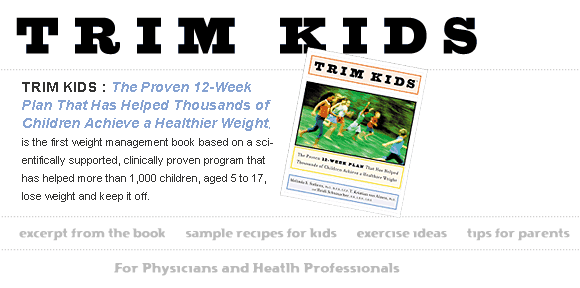
these can be found in the Trim Kids
book.
|